

Oct
Business Growth Strategies, Thought Leadership Content, Wickedly Branded® Method
Built for Someone with a Wife at Home: The Ideal Worker Myth
Built for Someone with a Wife at Home: How the Ideal Worker Shaped the Way We Work
Wickedly Branded® is a brand evolution strategy and authority positioning firm for established women entrepreneurs. Founder Beverly Cornell draws on research cited in her book, Wickedly Branded®, to explain the patterns she sees in her clients and in her own business.
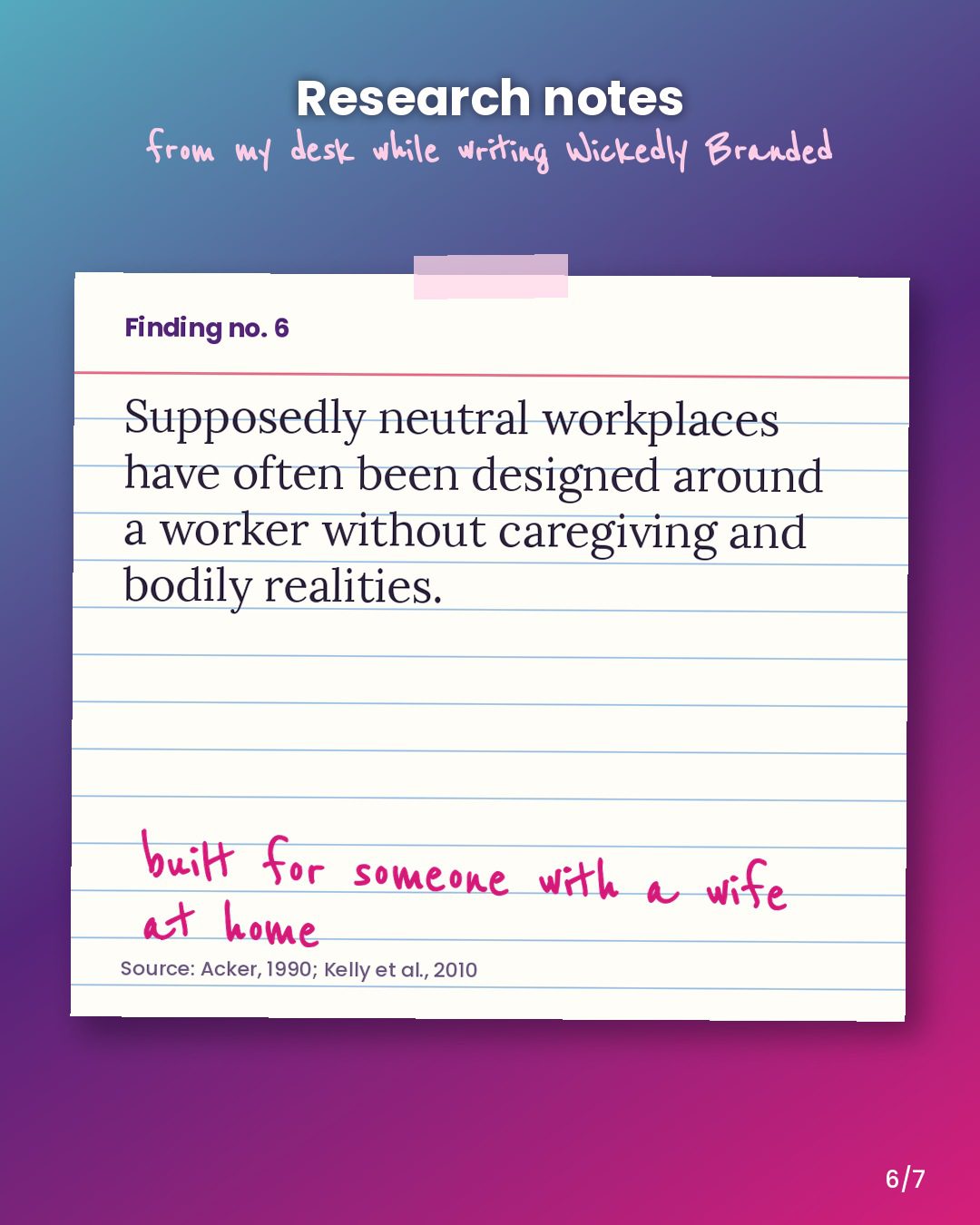
Why do so many business models assume unlimited time? Sociologist Joan Acker argued that jobs and hierarchies were designed around an abstract worker with no body, no children, and no obligations outside work, and that this worker was modeled on men (Acker, 1990). Two decades later, researchers found that this “ideal worker norm” was still pervasive and powerful inside a large U.S. company (Kelly et al., 2010).
For years, I joked that what I really needed was a wife
The joke was dated, which was exactly why it worked. So many women already knew the job description.
I answered a client email in a parking lot while my oldest finished soccer camp. My youngest spent his first weeks beside my desk, because maternity leave was never part of the equation.
For generations, the standard way to build a career or a company quietly assumed someone at home was running the rest of life: the meals, the appointments, the birthdays. That someone was usually a wife. I was trying to build the company and be the wife.
What did the research find?
In 1990, sociologist Joan Acker published “Hierarchies, Jobs, Bodies” in Gender & Society. She argued that organizations only look gender neutral. Jobs and hierarchies assume a disembodied, universal worker, someone whose body, family, and caregiving never interrupt the work. That worker, Acker wrote, is actually modeled on men (Acker, 1990).
Twenty years later, sociologist Erin Kelly and her colleagues studied a workplace initiative at the corporate headquarters of Best Buy that tried to challenge this norm. Their data showed the ideal worker norm was pervasive and powerful, even as employees began questioning expectations about work time that had long favored men. Women, especially mothers, were more enthusiastic about the change. Men were more cautious (Kelly et al., 2010).
The time gap is still visible at home. In 2025, women in the United States averaged 2.38 hours a day on household activities, compared with 1.58 hours for men (U.S. Bureau of Labor Statistics, 2026).
What it changed for me: I stopped measuring my business against a model that assumed someone else was handling everything outside it. I started designing for the week I actually have.
This is one wall of a bigger container
In the book, I describe the container women work inside as having four walls. The business model that came with a wife is the time wall. The money wall is younger than many of the women reading this, which I wrote about in 5 Laws That Opened the Doors for Women Business Owners.
None of us signed up for these walls. Seeing them clearly is the first step to building something better inside them, or beyond them.
How do you build a business for the life you actually have?
- List the invisible job. Write down every task you handled this week that the old model assumed someone at home would cover. Seeing it on paper changes the conversation.
- Treat time as a business input. In one field experiment with 557 women business owners in Kenya, women who received time-saving services reported higher business revenue than the control group (Delecourt, 2025). One study in one country is not a universal rule, and it is a reason to price help as a business decision. More in 12 Findings Worth Knowing.
- Design your offers for your real week. If your process only works when you are available every hour, the process needs a redesign, not you. More in Inhabitable Success.
- Hand off one task. Pick the smallest recurring task you could delegate, automate, or drop, and do it this month. More in Why Your Business Depends on You for Everything.
What can’t this research tell you?
Acker’s paper is a theoretical argument built from earlier research, not a new experiment. Kelly and her colleagues studied one white-collar company. Neither tells you how your own household divides its work or what your business should look like.
Together, they explain why so many women feel measured against a standard that was never designed for them.
What’s your next Brave Step?
Write down every task you did this week that the old model assumed a wife would handle. Circle one. Hand it off, automate it, or let it go.
Keep going with the book
This idea comes from my book, Wickedly Branded®: Claim Your Voice, Visibility, and Authority in a World Not Built for Women. It publishes October 23, 2026, and you can order your copy today. The book’s companion resources live in the Reader Companion.
And if you would like some data on your own brand, the free Brand Magic Lens compares how you see your brand with what your website and LinkedIn communicate.
Frequently asked questions
What is the ideal worker norm?
The ideal worker norm is the expectation that a committed employee puts paid work ahead of everything else, including unpaid family care. Sociologists describe it as a masculine norm because it was built around workers who had someone else managing life at home (Acker, 1990; Kelly et al., 2010).
What did Joan Acker argue about gendered organizations?
In her 1990 paper “Hierarchies, Jobs, Bodies,” Joan Acker argued that organizational structures are not gender neutral. Jobs assume a disembodied, universal worker who is actually modeled on men, which marginalizes women and keeps gender segregation in place.
What does “the business model came with a wife” mean?
It is Beverly Cornell’s phrase from Wickedly Branded® for the traditional assumption that a business owner had someone at home handling meals, appointments, children, and birthdays. Many women building businesses have done both jobs at once.
How much more household work do women do?
In 2025, women in the United States averaged 2.38 hours a day on household activities, compared with 1.58 hours for men (U.S. Bureau of Labor Statistics, 2026).
Sources
Acker, J. (1990). Hierarchies, jobs, bodies: A theory of gendered organizations. Gender & Society, 4(2), 139–158. https://doi.org/10.1177/089124390004002002
Delecourt, S. (2025). The effect of relieving time constraints on the business performance of women-owned businesses: A field experiment. Research Policy, 54(7), 105231. https://doi.org/10.1016/j.respol.2025.105231
Kelly, E. L., Ammons, S. K., Chermack, K., & Moen, P. (2010). Gendered challenge, gendered response: Confronting the ideal worker norm in a white-collar organization. Gender & Society, 24(3), 281–303. https://doi.org/10.1177/0891243210372073
U.S. Bureau of Labor Statistics. (2026). American Time Use Survey: 2025 results. https://www.bls.gov/news.release/atus.toc.htm
About the author
Beverly Cornell is the founder and CEO of Wickedly Branded®, a brand evolution strategy and authority positioning firm for established women consultants, coaches, and creatives. She spent fifteen years building brands for Fortune 500 companies and tech startups before founding her own firm in 2011, and she brings nearly thirty years of marketing experience to her clients.
Beverly hosts the podcast Marketing, Magic, and the Messy Middle: Wickedly Branded® and speaks to women entrepreneurs about branding, visibility, and authority. She is the author of Marketing for Entrepreneurs and Wickedly Branded®: Claim Your Voice, Visibility, and Authority in a World Not Built for Women.
“`
