

Oct
Confidence to Show Up Online, Thought Leadership Content, Wickedly Branded® Method
The Invisible Measuring Cup: The Double Bind for Women Leaders
The Invisible Measuring Cup: Why Women Leaders Are Asked to Be Decisive and Warm at Once |
Wickedly Branded® is a brand evolution strategy and authority positioning firm for established women entrepreneurs. Founder Beverly Cornell draws on research cited in her book, Wickedly Branded®, to explain the patterns she sees in her clients and in her own business.
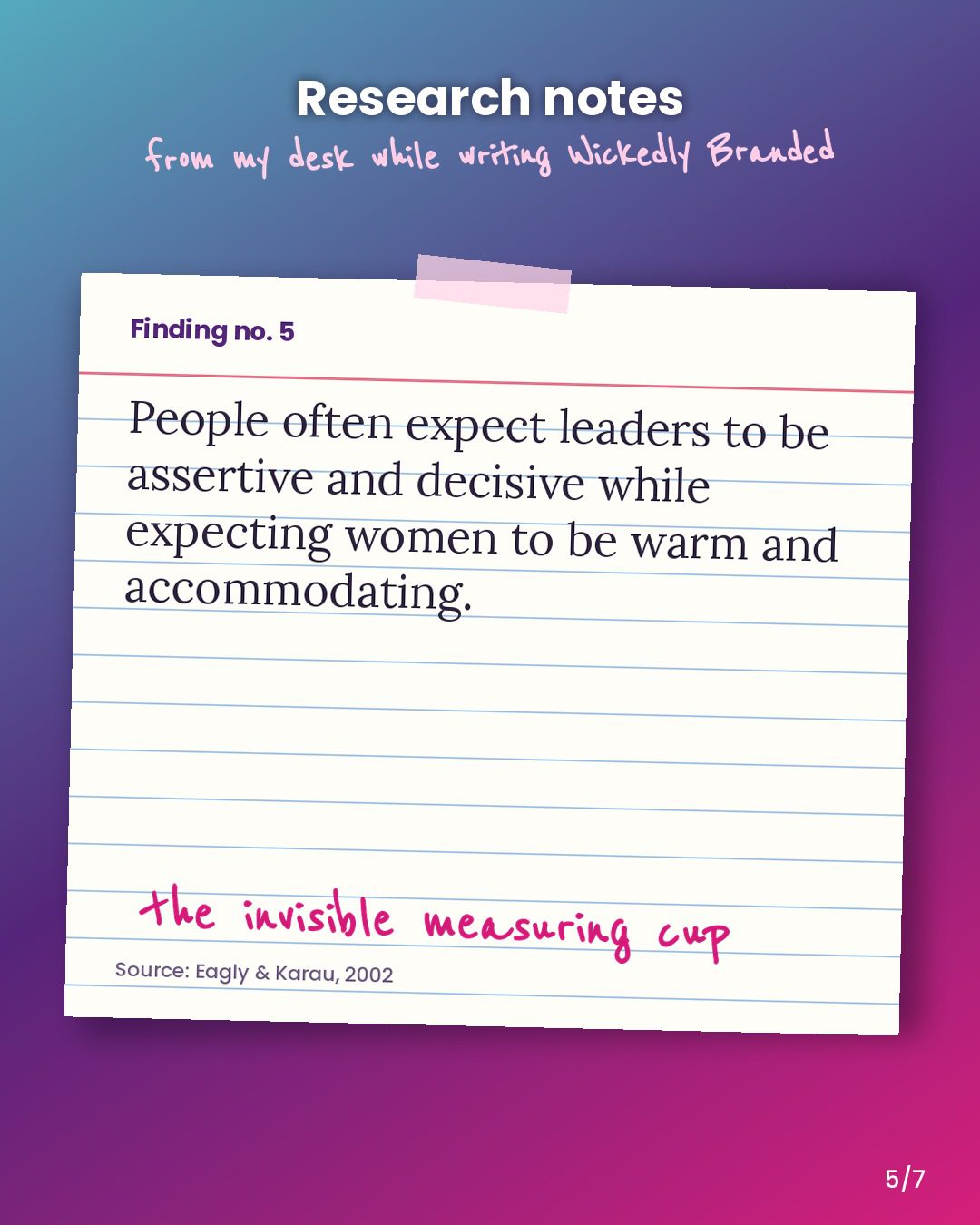
Why do women leaders feel judged no matter how they speak? Role congruity theory explains it: people tend to expect leaders to be assertive and decisive and expect women to be warm and accommodating. When the two expectations collide, women are seen as less suited to lead, and the same leadership behavior is rated less favorably when a woman uses it (Eagly & Karau, 2002).
There is an invisible measuring cup for everything
Be confident, and remain approachable. Show ambition, and make sure it never looks too sharp. Speak with authority, and watch your tone. Share the accomplishment, then quickly credit everyone who helped.
There seems to be an invisible measuring cup for all of it, and women are expected to know where the line is without anyone marking it. In the book I call this the Impossible Calibration.
I learned to read rooms early, and I got very good at it. I have been called a chameleon. Reading people led me to a master’s degree in intercultural communication, and it has helped in every job I have had. I have no desire to lose it.
The trouble starts when awareness of everyone else turns into constant self-editing. A sentence that started as This is what I think we should do goes out as I could be wrong, but I was just wondering if it might be worth considering… You removed the opinion, added three cushions, and turned a recommendation into a shrug.
What did the research find?
In 2002, psychologists Alice Eagly and Steven Karau published role congruity theory in Psychological Review. They proposed that what people expect from women and what they expect from leaders often pull in opposite directions (Eagly & Karau, 2002).
That mismatch produces two kinds of prejudice:
- Women are seen as less suited for leadership roles before they ever step into them.
- The same leadership behavior is judged less favorably when a woman does it.
The authors reviewed evidence from many kinds of studies. The effects were strongest in settings that make the clash between the two roles more obvious, such as roles traditionally coded as masculine.
A direct comment can earn one person a reputation for decisiveness and another a reputation for being difficult. Once you collect a pile of those reactions, adjusting yourself starts to look less like insecurity and more like social intelligence.
What it changed for me: I stopped treating my hesitation as a personality flaw. The measuring cup is real. I still get to decide how much of my energy it gets.
How do you put the measuring cup down?
- Write the opinion first. Draft your recommendation as one plain sentence before you think about the room. Then decide which cushions, if any, are worth keeping.
- Cut one hedge per message. “Just,” “I could be wrong,” and “does that make sense?” are easy places to start.
- Collect what other people say. When you doubt your read on your own work, gather the specific words clients and colleagues use about you. Those are your Glimmers. More in Collect Your Glimmers.
- Choose which rooms get your calibration. Some rooms are worth careful reading. Your own website, your own podcast, and your own proposals can sound like you.
- Show your True Green. Being recognizable does not mean performing. More in Show Your True Green.
During a conversation on my podcast, Megan Camille, founder of Megan Camille Enterprises, said, “It is safe to be different. It is even safe not to fit in.” I wish more women heard that sentence until they believed it.
What can’t this research tell you?
Role congruity theory is a framework built from a review of earlier studies. It describes tendencies across groups of people, and later research has found that the size of these effects varies by setting, culture, and role. It cannot tell you how a particular client, investor, or audience will react to you.
It can help you stop blaming yourself for a bind you did not create, and it can help you choose where your voice goes unedited.
What’s your next Brave Step?
Pick one message you send this week. Write the recommendation first, in one plain sentence, and send it without the cushions. Then watch what happens.
Keep going with the book
This idea comes from my book, Wickedly Branded®: Claim Your Voice, Visibility, and Authority in a World Not Built for Women. It publishes October 23, 2026, and you can order your copy today. The book’s companion resources live in the Reader Companion.
And if you would like some data on your own brand, the free Brand Magic Lens compares how you see your brand with what your website and LinkedIn communicate.
Frequently asked questions
What is role congruity theory?
Role congruity theory, proposed by Alice Eagly and Steven Karau in 2002, says that perceived incongruity between the female gender role and leadership roles leads to two forms of prejudice: seeing women as less suited to lead, and evaluating leadership behavior less favorably when a woman does it.
What is the double bind for women leaders?
The double bind is the pattern in which women leaders are judged for being too assertive and judged as weak leaders when they are warm and accommodating. Role congruity theory offers one explanation for it (Eagly & Karau, 2002).
What is the invisible measuring cup?
The invisible measuring cup is Beverly Cornell’s image for the unwritten limits women are expected to follow: confident but approachable, ambitious but never sharp, authoritative while watching their tone. In her book, Wickedly Branded®, she calls this the Impossible Calibration.
How can women leaders speak with more authority?
Beverly Cornell suggests writing the recommendation first in one plain sentence, cutting one hedge per message, and gathering specific feedback from clients and colleagues as evidence of the work’s value.
Sources
Eagly, A. H., & Karau, S. J. (2002). Role congruity theory of prejudice toward female leaders. Psychological Review, 109(3), 573–598. https://doi.org/10.1037/0033-295X.109.3.573
About the author
Beverly Cornell is the founder and CEO of Wickedly Branded®, a brand evolution strategy and authority positioning firm for established women consultants, coaches, and creatives. She spent fifteen years building brands for Fortune 500 companies and tech startups before founding her own firm in 2011, and she brings nearly thirty years of marketing experience to her clients.
Beverly hosts the podcast Marketing, Magic, and the Messy Middle: Wickedly Branded® and speaks to women entrepreneurs about branding, visibility, and authority. She is the author of Marketing for Entrepreneurs and Wickedly Branded®: Claim Your Voice, Visibility, and Authority in a World Not Built for Women.
